A Wake-Up Call Every Indian Should Notice
A brain stroke is one of the leading causes of death and disability in India—yet most people fail to recognize its warning signs until it’s too late.
Recently, former Indian cricketer Vinod Kambli came into the spotlight after reports revealed a serious brain condition involving a blood clot that may lead to a stroke. His situation is not just a sports story—it’s a powerful reminder of a health risk that can affect anyone, regardless of their background.
Do you know how to identify a stroke before it becomes fatal?
What Is a Brain Stroke?
A brain stroke (also called a cerebrovascular accident or CVA) happens when blood flow to a part of the brain suddenly stops. Without oxygen and nutrients, brain cells begin to die within minutes.
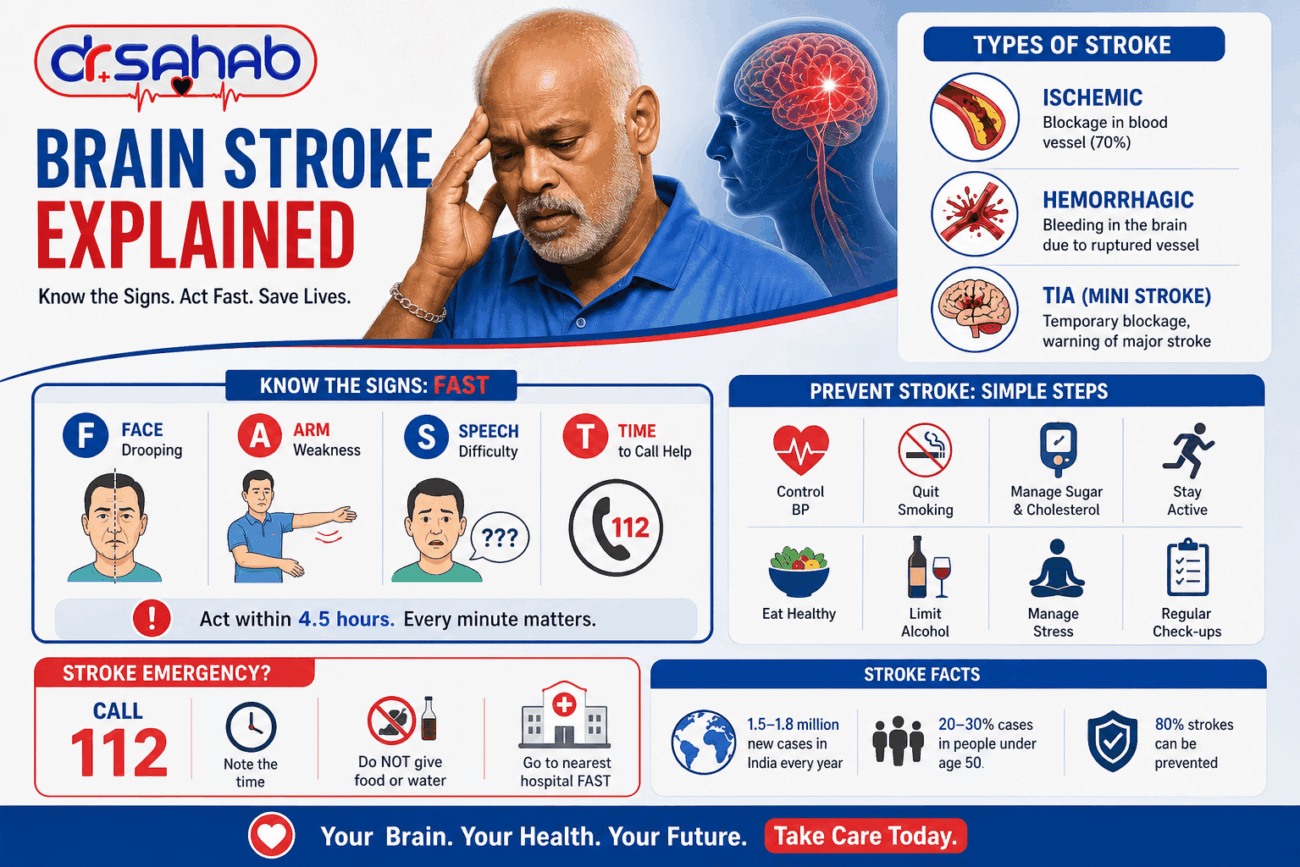
Types of Brain Stroke
- Ischemic Stroke (Most Common): Caused by a blood clot blocking an artery. This accounts for around 60–70% of all cases. Think of it like a traffic jam where blood can’t reach the brain.
- Hemorrhagic Stroke: Happens when a blood vessel bursts, often linked to high blood pressure. This is more dangerous, though less common.
- TIA (Mini Stroke): A temporary blockage where symptoms disappear quickly. Warning: This is often a sign of a major stroke coming soon.
Causes & Risk Factors of Brain Stroke
Most strokes don’t happen suddenly—they build up over time due to lifestyle and health conditions.
- High Blood Pressure (Hypertension): The #1 cause. It damages blood vessels over time.
- Smoking & Tobacco Use: Narrows blood vessels and increases clot risk.
- Diabetes: High sugar levels damage arteries.
- Obesity & Lack of Exercise: Leads to poor circulation and high cholesterol.
- Air Pollution: An emerging major contributor to stroke risk in Indian cities.
- Alcohol Consumption: Heavy drinking increases blood pressure and irregular heart rhythms.
Stroke Statistics: Why India Should Be Worried
- 12.2 million new stroke cases globally every year.
- 1.5–1.8 million stroke cases per year occur in India alone.
- 20–30% of cases in India occur in people under age 50.
Note: Stroke is no longer just an “old age disease.” Young professionals in India are increasingly at risk due to high stress and sedentary lifestyles.
Early Warning Signs: The FAST Rule
Time is brain. Every minute matters when a stroke occurs. To save a life, remember the FAST rule:
- F — Face Drooping: Is one side of the face drooping or numb?
- A — Arm Weakness: Is one arm weak or numb? Ask the person to raise both arms.
- S — Speech Difficulty: Is speech slurred? Can they repeat a simple sentence?
- T — Time to Call Help: If any of these signs are present, call emergency services immediately.
Other Symptoms include: Sudden severe headache, loss of balance, or blurred vision.
How to Prevent Brain Stroke (8 Simple Steps)
The good news is that up to 80% of strokes are preventable with lifestyle changes:
- Control Blood Pressure: Keep it below 130/80 mmHg and reduce salt intake.
- Quit Smoking: Even reducing the count helps significantly.
- Manage Sugar & Cholesterol: Regular blood tests are a must after age 30.
- Stay Physically Active: At least 30 minutes of brisk walking daily.
- Eat a Brain-Healthy Diet: Focus on fruits, vegetables, and whole grains.
- Limit Alcohol: Avoid heavy drinking to maintain heart rhythm.
- Manage Stress: Practice meditation or yoga to keep cortisol levels in check.
- Regular Health Check-ups: Don’t ignore minor health issues.
What to Do During a Stroke Emergency
🚨 Act immediately within the “Golden Hour” (first 4.5 hours):
- Call emergency services or rush to a hospital with CT-Scan facilities.
- Do NOT give the person any food or water.
- Note the exact time when the symptoms first started.
Conclusion
The case of Vinod Kambli is a reminder that brain stroke can affect anyone—celebrity or common person. Your daily habits—what you eat, how much you move, and how you manage stress—decide your future. Take your brain health seriously; you only get one.
FAQs About Brain Stroke
Q1. What is the first sign of a stroke?
The most common first signs are face drooping, arm weakness, and slurred speech.
Q2. Can a stroke be fully prevented?
While genetics play a role, 80% of strokes are preventable through a healthy diet, exercise, and controlling BP.
Q3. Is stroke common in young people in India?
Yes, lifestyle stress and pollution have led to 20-30% of stroke cases occurring in people under 50.
Q4. What is the “Golden Hour” in stroke?
The first 4.5 hours after symptoms start are critical for medical treatment to reverse or minimize brain damage.
About Author: Dr-Sahab Health Desk – Committed to bringing you verified health insights for a better lifestyle.
📚 References
🌍 Global Stroke Data
- The Lancet Neurology — GBD 2019 Stroke Study
https://www.thelancet.com/journals/laneur/article/PIIS1474-4422(21)00252-0/fulltext - World Stroke Organization — Global Stroke Fact Sheet 2025
https://www.world-stroke.org/assets/downloads/WSO_Global_Stroke_Fact_Sheet.pdf - American Heart Association — Stroke Journal
https://www.ahajournals.org/journal/str - International Journal of Stroke — Global Stroke Statistics 2022
https://journals.sagepub.com/home/wso
🇮🇳 India-Specific Data
- PubMed Central / NIH (Stroke in India Review)
https://www.ncbi.nlm.nih.gov/pmc/articles/PMC6996227/ - Nature Scientific Reports (India Stroke Data)
https://www.nature.com/articles/s41598-022-05400-4 - The Lancet Regional Health – Southeast Asia
https://www.thelancet.com/journals/lansea/home - Indian Journal of Medical Research
https://journals.lww.com/ijmr/pages/default.aspx - Neurology India
https://journals.lww.com/neurologyindia/pages/default.aspx
🏏 Vinod Kambli Health Updates
- Hindustan Times
https://www.hindustantimes.com - News9Live
https://www.news9live.com - CricToday
https://crictoday.com - One World News
https://www.oneworldnews.com
